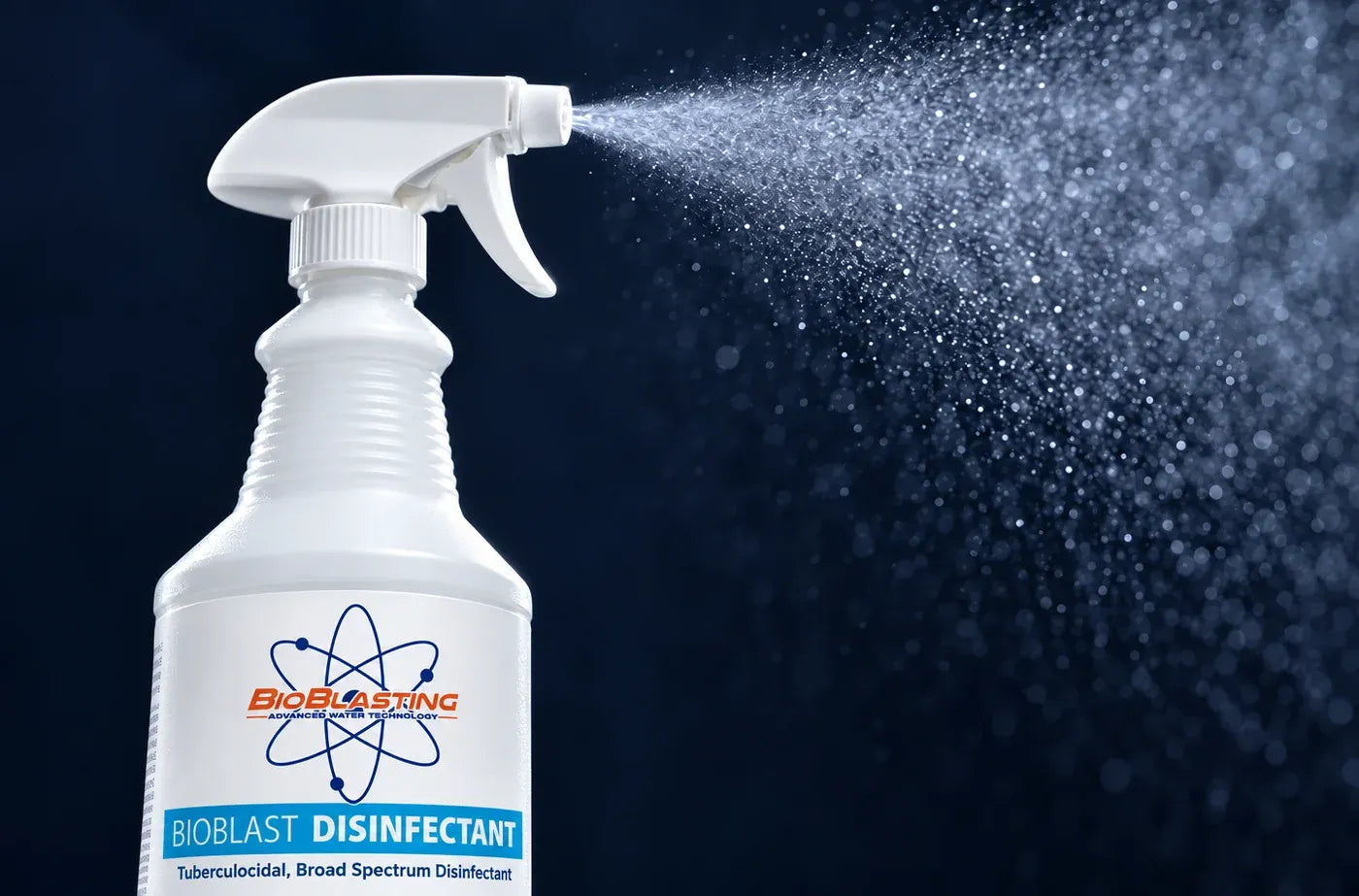
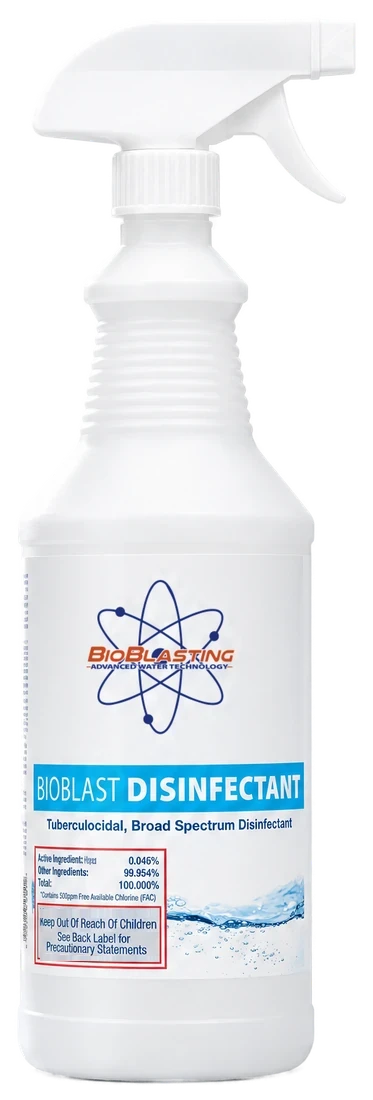
BioBlast Disinfectant®
Label directions and contact times.
What BioBlast Disinfectant® works against, how long to leave it wet, and how to use it, straight from the product label.
How to use
Clean. Apply. Wait. Dry.
-
Pre-clean
For visibly soiled areas, clean the surface first.
-
Apply
Wipe, spray, mop or dip onto hard, non-porous surfaces.
-
Keep it wet
Treated surfaces must stay wet for 10 minutes (2 minutes for Hepatitis C and Influenza A).
-
Air dry
Let surfaces air dry.
Organisms on the label
What it works against.
Contact time is 10 minutes unless otherwise noted.
-
Bacteria · 10 min
Clostridium difficile spores (C. diff), Escherichia coli (E. coli), Klebsiella pneumoniae NDM-1 (carbapenem resistant), Listeria monocytogenes, MRSA (methicillin-resistant Staphylococcus aureus), Pseudomonas aeruginosa, Salmonella enterica, Staphylococcus aureus, VRE (vancomycin-resistant Enterococcus faecalis), Bordetella bronchiseptica (kennel cough)
-
Mycobacterium · 10 min
Mycobacterium bovis BCG (tuberculosis, TB)
-
Non-enveloped viruses · 10 min
Adenovirus type 1, Norovirus (as feline calicivirus), Rhinovirus type 16, Rotavirus group A, SARS-CoV-2, the novel coronavirus that causes COVID-19 (emerging pathogen, see Norovirus)
-
Enveloped viruses · 10 min
Hepatitis C virus (2 min, as bovine viral diarrhea virus), HIV-1, Influenza A H1N1 (2 min), RSV (respiratory syncytial virus), Swine flu H1N1, Canine distemper
-
Parvovirus · 10 min
Canine parvovirus
-
Yeast · 10 min
Candida albicans
Directions for use
Full label directions.
Hard, non-porous surfaces. For visibly soiled areas, a preliminary cleaning is required. Apply, wipe, spray or dip BioBlast Disinfectant® at 500 ppm FAC onto hard, non-porous surfaces with a cloth, wipe, mop or sponge. Treated surfaces must remain wet for 10 minutes. Allow surfaces to air dry.
Special Instructions for Cleaning Prior to Disinfection against Clostridium difficile endospores:
Personal Protection: Wear appropriate barrier protection such as gloves, gowns, masks, or eye covering.
Cleaning Procedure: Fecal matter/waste must be thoroughly cleaned from surfaces/objects before disinfection by application with clean cloth, mop, and/or sponge saturated with product intended for disinfection. Cleaning should include vigorous wiping and scrubbing, until visible soil is removed. Special attention is needed for high-touch surfaces. Surfaces in patient rooms are to be cleaned in an appropriate manner, such as from right to left or left to right, on horizontal surfaces, and top to bottom, on vertical surfaces, to minimize spreading of the spores. Restrooms are to be cleaned last. Do not reuse soiled cloths.
Infectious Materials Disposal: Cleaning materials used that may contain feces/wastes should be disposed of immediately in accordance with local regulations for infectious materials disposal.
Killing Clostridium difficile: Clean hard, non-porous surfaces by removing gross filth, loose dirt, debris, blood/bodily fluids, etc. Apply this product and let stand for 10 minutes.
Special Instructions for Using this product to Clean and Decontaminate against HIV on Surfaces/Objects Soiled with Blood/Body Fluids
This product kills HIV-1 on pre-cleaned environmental surfaces/objects previously soiled with blood/body fluids in health care settings (e.g. hospitals, nursing homes) or other settings in which there is an expected likelihood of soiling of inanimate surfaces/objects with blood or body fluids, and in which the surfaces/objects likely to be soiled with blood or body fluids can be associated with the potential for transmission of Human Immunodeficiency Virus Type 1 (HIV-1) associated with AIDS.
Personal Protection: When handling items soiled with blood or body fluids, use appropriate barrier protection such as disposable latex gloves, gowns, masks, and eye coverings. Cleaning Procedure: Blood and other body fluids must be thoroughly cleaned from surfaces and other objects before applying this product.
Contact Time: Apply to area to be treated. Let stand for 10 minutes. Cleaning materials used that may contain feces/wastes should be disposed of immediately in accordance with local regulations for infectious materials disposal.
Disposal of Infectious Material: Blood and other body fluids must be autoclaved and disposed of according to local regulations for infectious waste disposal.
Surfaces to avoid. Do not use on steel, aluminum, silver or chipped enamel. Prolonged contact with metal may cause pitting or discoloration. Test first in an inconspicuous spot.
Storage. Store in a closed, dark plastic container away from direct sunlight, in a cool, dry area.
It is a violation of Federal law to use this product in a manner inconsistent with its labeling.